The Popularity Games evolved a lot from its first incarnation. However, it was always going to be a mystery novel. I loved reading Nancy Drew and learning about true cases growing up, and I went through a detective phase where I would carry a magnifying glass around and search around the pine trees outside in the pitch dark back when I lived in a brown and orange house before it got flooded out when I was eight. It may have been short-lived (I only filled out two diary pages as a kid about imaginary cases and perhaps real ones in my life), but it's always stuck with me. I don't know if I've read a full-fledged mystery novel in a long time (This Is Where the World Ends may count),
However, my narrator wasn't always going to be a snarky redhead with a courageous drive to figure out who murdered the popular girl in school. Yes, the original TPG was about the death of #1 at a high school, but the original redhead wasn't going to be at all strong. In fact, she wasn't the only narrator. It also wasn't originally supposed to be humorous or even have some of the snappy dialogue that I've included in the final product of the first draft.
Do you wanna know what the original TPG was going to be about? My 13 year old self was proud about it, but the me of now? I kinda just want to cringe thinking about this.
Here we go. Brace yourselves *takes deep breath*. The Popularity Games was originally going to be about four high school girls: a rebellious tomboy who played football, Ann; a supermodel (that's all I got), Joana; the principal's secret daughter who was called in from overseas to investigate something, Riley; and the BFF to the most popular girl in school who was nasty yet had a soft side to her, Star (I think her real name was Stacey). Combine those four first-person point of views with an incredibly prestigious private school called Robin Crest (which was borrowed from something I tried to write in fifth grade that was more of a slice of life drama, Little Rock, which was also just as tacky; there was a girl named Falcon) and popularity being a literal game (probably my favorite part of the original concept), and we have our story, ladies and gentlemen. Think of it like Pretty Little Liars meets whatever thriller you can find, and presto! Instant classic!
Showing posts with label realisticfiction. Show all posts
Saturday, July 9, 2016
Sunday, April 10, 2016
Luke's Book Reviews #8: This Is Where the World Ends by Amy Zhang
Do you ever have those authors who wrote a first book that you absolutely loved, and because of that, you wait for their next title with bated breath? That happened to me with Amy Zhang's debut Falling into Place, a skillfully written novel about the most popular girl in school attempting to commit suicide following Newton's Three Laws of Motion. Not only was the novel published when Zhang was only 18 (*applause*), but I remember sitting on the couch back in December 2014 and reading the last 100 or so pages while holding back tears/squealing because I loved it so much. The book was written in an interesting fashion, utilizing the nonlinear style and an interesting narrator to tell the story from multiple points of view. Although the subject matter itself had been seen before, it was done in such a unique way that I couldn't help but find it a gem.
Due to my love for her debut, Zhang's second release was eagerly awaited by me, and although all it had was a title for nine months, I was excited nevertheless. When the cover came out, I was more excited than ever because a) LOOK AT THE PRETTY! and b) the synopsis sounded amazing. However, reviews for the ARCs started rolling in a couple months later, and a lot of people had mixed feelings about it. For one thing, they said that the synopsis actually had a huge spoiler in it (you might be able to guess it from the cover), and that although the writing was good, they didn't seem to like our characters and found them really unlikable. I was surprised by these reviews, most notably because I wasn't getting any particular predictable vibes from the novel, and the fact that Zhang had made Liz sympathetic in Falling into Place even though she could be incredibly cruel to her fellow classmates and even her friends. I had some mild hesitation going into this, but I still had high hopes, and once this came into the library on hold for me, I swooped it up and immediately dug in.
So, how was This Is Where the World Ends? Was it on the level of Amy Zhang's debut novel, or were there some pieces missing to make everything complete?
Due to my love for her debut, Zhang's second release was eagerly awaited by me, and although all it had was a title for nine months, I was excited nevertheless. When the cover came out, I was more excited than ever because a) LOOK AT THE PRETTY! and b) the synopsis sounded amazing. However, reviews for the ARCs started rolling in a couple months later, and a lot of people had mixed feelings about it. For one thing, they said that the synopsis actually had a huge spoiler in it (you might be able to guess it from the cover), and that although the writing was good, they didn't seem to like our characters and found them really unlikable. I was surprised by these reviews, most notably because I wasn't getting any particular predictable vibes from the novel, and the fact that Zhang had made Liz sympathetic in Falling into Place even though she could be incredibly cruel to her fellow classmates and even her friends. I had some mild hesitation going into this, but I still had high hopes, and once this came into the library on hold for me, I swooped it up and immediately dug in.
So, how was This Is Where the World Ends? Was it on the level of Amy Zhang's debut novel, or were there some pieces missing to make everything complete?
Monday, December 21, 2015
Luke's Anime Reviews #1: Soul Eater NOT!
Prequels are an interesting case in any medium. Usually, they're released after an original series has had success. Sometimes they're focused on the same characters before the events of the main story, or the leads are completely different characters. Things like The Kill Order by James Dashner, The Hobbit by J.R.R. Tolkien, or The Infernal Devices series by Cassandra Clare (with more stuff from her on the way, much to everyone's joy and anger) are examples in the book world, and Fate/Zero sticks out as a primary example in anime. They seem to only attract people who have read the stuff that came before it, which seems strange to me. Wouldn't some people prefer to go into the work that takes place before the main book or series starts?
Soul Eater NOT! is another one of those special cases. First published as a spin-off to Soul Eater in January 2011, the series took place prior to the events in the first series and with different characters as the leads. The minute I saw the manga at Barnes & Noble, I knew it would eventually be adapted into an anime series, and when the announcement arrived, I wasn't surprised in the slightest. I managed to watch a couple of episodes as it was airing in the spring of 2014, but I wasn't able to finish the series until as of recently, when I got the chipboard box set for my birthday.
For some reason, people love to hate on this series, mostly because of its animation and because it's the complete opposite of Soul Eater in pretty much every aspect. I've only been able to watch 25 episodes of the original series in the past 3 years, which is really unfortunate (I mean, I got the series for Christmas 2 years ago, you would think that I would be caught up now). Alas, I still wanted to experience Soul Eater NOT!, and I knew I would be in for a fun ride.
So what happened? Did Soul Eater NOT! turn out to be fun? Or was it disappointing?
Saturday, November 7, 2015
Luke's Book Reviews #6: This One Summer by Jillian and Mariko Tamaki
When I was growing up, I stumbled upon a graphic novel series called Babymouse in Barnes & Noble. This sparked a genuine interest in picking up the third book called Beach Babe, and I immediately became hooked. To this day, some of my funniest memories come from reading that pink, black, and white series, and because of Babymouse, I've picked up graphic novels by Raina Telgemeier and read manga ranging in genres from shonen to shojo.
My occasional thirst for graphic novels and manga still remains today, and sometimes I need a break from the occasional YA fantasy or realistic fiction book. That's why I decided to pick up This One Summer. I hadn't heard much about it going in, but I did see the Printz Honor and Caldecott Honor stamps, which meant that this book had been met with critical acclaim. Would that mean that I would like it? I decided to read and find out.;
So how was This One Summer? Was it a nice break from all of those novels? Or was it an ultimately forgettable experience?
Thursday, October 29, 2015
The Story Behind Duet
Duet started with my own personal need to write a realistic fiction novel. Despite writing two trilogies with fantastical features (one more science fiction and the other fantasy), I wanted to take a break from inventing new worlds and having people possess special powers. I wanted to write a novel that wouldn't be surprising to find in Sarah Dessen's collection, a novel where the setting was realistic (albeit with some minor changes) with a teenager going through a coming of age experience with a developing romance on the side (because you know I love my romance).
But there was going to be something different: the romance I had in mind was a gay one.
Gay romance isn't anything new in the YA market (I've stressed this before in my Boy Meets Boy review, where I also went into a brief rant about the unequal representation in mainstream New Adult and Adult fiction), and I have actually written three Bleach Hollow Ichigo (Hichigo) and Ichigo fanfictions featuring that explicitly (one was a one-shot called Beating Heart, and the other was a multi-chapter AU that I'm still incredibly proud of to this day, Claws of a Dragon; the third one is forthcoming). But I had never invented male characters who had feelings for other male characters, and this was a great opportunity to try this out. Plus, I wanted this to be a full-length novel of at least 50,000 words (much like the average length of a NaNiWriMo novel), not under 25,000.
But you may be wondering: why a gay romance, Luke? What was so bad about writing heterosexual romances? My answer to those questions is absolutely nothing, but it has to do with one of the key phrases I've kept in mind while writing this novel.
I've always said several times before that Duet is my most personal novel to date. Every single time I've typed in those words, I have meant it. Duet was partly inspired by my own questioning sexuality, and although it's played rather simply in the novel (Cam doesn't question his sexuality for one minute anywhere in Duet, only what his parents might think), it's been a lot more complicated in real life.
But there was going to be something different: the romance I had in mind was a gay one.
Gay romance isn't anything new in the YA market (I've stressed this before in my Boy Meets Boy review, where I also went into a brief rant about the unequal representation in mainstream New Adult and Adult fiction), and I have actually written three Bleach Hollow Ichigo (Hichigo) and Ichigo fanfictions featuring that explicitly (one was a one-shot called Beating Heart, and the other was a multi-chapter AU that I'm still incredibly proud of to this day, Claws of a Dragon; the third one is forthcoming). But I had never invented male characters who had feelings for other male characters, and this was a great opportunity to try this out. Plus, I wanted this to be a full-length novel of at least 50,000 words (much like the average length of a NaNiWriMo novel), not under 25,000.
But you may be wondering: why a gay romance, Luke? What was so bad about writing heterosexual romances? My answer to those questions is absolutely nothing, but it has to do with one of the key phrases I've kept in mind while writing this novel.
I've always said several times before that Duet is my most personal novel to date. Every single time I've typed in those words, I have meant it. Duet was partly inspired by my own questioning sexuality, and although it's played rather simply in the novel (Cam doesn't question his sexuality for one minute anywhere in Duet, only what his parents might think), it's been a lot more complicated in real life.
Sunday, September 27, 2015
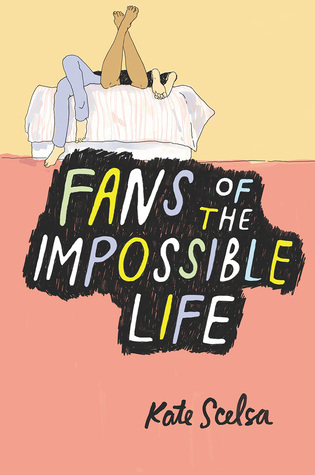
Luke's Book Reviews #5: Fans of the Impossible Life by Kate Scelsa
Realistic fiction has always been one of my biggest staples when it comes to reading. Sure, I like fantasy worlds and futuristic societies, but books about real life experiences set in the modern day will always stay close to my heart, especially now that I'm growing up. That's why most of the books I read are in this genre, this book included.
I was immediately sucked into reading this book via the tagline: "This is a story of a girl, her gay best friend, and the boy in love with both of them." The possibility of a bisexual love triangle was calling out to me, and the actual plot itself sounded interesting. Books about characters breaking out of their shells are always fun to read, and when I got this book from the library, I was ready to become a fan of Fans of the Impossible Life.
What exactly happened in Fans of the Impossible Life? Was it a rewarding, satisfying read that followed interesting characters and a heartfelt character arc? Or was it an average, run-of-the-mill realistic fiction novel that did nothing to stand out?
I was immediately sucked into reading this book via the tagline: "This is a story of a girl, her gay best friend, and the boy in love with both of them." The possibility of a bisexual love triangle was calling out to me, and the actual plot itself sounded interesting. Books about characters breaking out of their shells are always fun to read, and when I got this book from the library, I was ready to become a fan of Fans of the Impossible Life.
What exactly happened in Fans of the Impossible Life? Was it a rewarding, satisfying read that followed interesting characters and a heartfelt character arc? Or was it an average, run-of-the-mill realistic fiction novel that did nothing to stand out?
Sunday, September 13, 2015
Luke's Book Reviews #4: Cut Both Ways by Carrie Mesrobian
When I first read the synopsis for Cut Both Ways, I immediately hit the TBR button on Goodreads. I mean, I rarely see bisexuality in any of the books I read, and from the way the synopsis sounded, this sounded like a perfect self-discovery book for someone my age to read.
I've had my own confusions about my sexuality, and sometimes I turn to books to see how authors write their own characters in situations like my imagination. So, without much further thought, I put Cut Both Ways on hold at my library and waited patiently for it to come in. Once I got it, I was already flipping through the pages.
Now comes the difficult part. How was Cut Both Ways? Was it a moving book that was written well and had a character that I could like? Or was it the exact opposite of what I wanted?
Tuesday, September 1, 2015
Luke's Book Reviews #3: Burying Water by K.A. Tucker
New Adult is one of those genres that has popped up a lot in the past couple of years. The term was coined to signify novels in the age group of about 18 to 22 year olds (and a little above that) to provide a middle ground between young adult and adult fiction. The genre includes mostly college aged people finding love, and romantic scenes are a lot more explicit than in YA (they're probably close to the level of some erotic adult romances).
Although there are some that are light and fluffy, others have a bit of an edge to them. Examples that immediately pop into my head are After by Anna Todd (which I gave up on around the halfway point because the book wasn't that great) and Confess by Colleen Hoover (which I read and thoroughly enjoyed). The former focused on an on-and-off relationship that was abusive at some parts, while the latter was more attentive to a budding relationship with an artist and hairdresser (both with their own secrets). But there are definitely other ones than the two I mentioned, and I definitely believe this would fall onto that list.
I first found Burying Water at Barnes & Noble on a Realistic Romance endcap. Reading the synopsis made me very intrigued, as I realized that it was more of a romantic suspense novel than just a plain romance. I later discovered that this book is actually the first in a (so far) four book series (the books are unrelated and could be read out of order or randomly, but are read best in order because characters from previous books are mentioned, show up, or are explained) which has different forms of water in the titles (hence why I will name this series the Water series). Knowing that, I was further convinced that I would start here in the lines of books in K.A. Tucker's collection, instead of beginning with Ten Tiny Breaths (an originally self-published book that managed to be picked up by a major publishing company and made her a household name).
So, how was Burying Water? Did it keep me on the edge of my toes, but did it also have me swooning? Or was most of it boring and dull, with the romance having no real drive to make it interesting?
Although there are some that are light and fluffy, others have a bit of an edge to them. Examples that immediately pop into my head are After by Anna Todd (which I gave up on around the halfway point because the book wasn't that great) and Confess by Colleen Hoover (which I read and thoroughly enjoyed). The former focused on an on-and-off relationship that was abusive at some parts, while the latter was more attentive to a budding relationship with an artist and hairdresser (both with their own secrets). But there are definitely other ones than the two I mentioned, and I definitely believe this would fall onto that list.
I first found Burying Water at Barnes & Noble on a Realistic Romance endcap. Reading the synopsis made me very intrigued, as I realized that it was more of a romantic suspense novel than just a plain romance. I later discovered that this book is actually the first in a (so far) four book series (the books are unrelated and could be read out of order or randomly, but are read best in order because characters from previous books are mentioned, show up, or are explained) which has different forms of water in the titles (hence why I will name this series the Water series). Knowing that, I was further convinced that I would start here in the lines of books in K.A. Tucker's collection, instead of beginning with Ten Tiny Breaths (an originally self-published book that managed to be picked up by a major publishing company and made her a household name).
So, how was Burying Water? Did it keep me on the edge of my toes, but did it also have me swooning? Or was most of it boring and dull, with the romance having no real drive to make it interesting?
Friday, August 14, 2015
Luke's Book Reviews #2: Boy Meets Boy by David Levithan
I really like gay romance in fiction. I just find a relationship between two people of the same gender (mostly two boys) absolutely fascinating, and I really love that some people in real life have chosen to stay true to who they are and not live up to the straight status quo and pretend to be someone they're not. However, I don't feel as if these kinds of books have ever really been part of the mainstream reading world outside of young adult. Sure, you have titles like Simon vs. the Homo Sapiens Agenda, More Happy Than Not, Lies My Girlfriend Told Me, and others from the past five years or so in young adult, but I almost never really see it in the adult romance or fiction sections at the bookstore (maybe that's because I mainly focus on young adult and hardly spend my time elsewhere, but no matter how many times I've looked, I've never found a new adult or adult gay romance published from major companies (they're published a lot more independently)).
I don't know if this is because gay romance is a harder thing to sell in a different market (like adult or children's), or if publishers think teenagers relate to sexuality the most and don't think other people experience it too. I think that's not true, because I'm pretty sure there are kindergartners right now who may have different kinds of feelings (feelings for same sex, want to be different gender), but don't feel as if they can read anything that supports that.
Young adult fiction had that phase too, and this was one of the books that changed it. Boy Meets Boy was first published in 2003 (another well-known YA book with LGBT characters, Geography Club, was also released in that year) and was very blunt about what it was. When you see the title of the book and relate that to the candy hearts, you immediately know "This is a gay romance". Some people would turn away at this point, but I was very much intrigued. Like I said before, I love reading about guys kissing (the fanfictions have affected my brain), but I also knew that this book was going to be a light and fluffy read filled with fun times (my brother also absolutely adored it).
So how was this book? Were the 185 pages (yes, that's how long it is) cute and fun, filled with a cute romance, real teen issues, and things I could relate to? Or was it a disappointment?
I don't know if this is because gay romance is a harder thing to sell in a different market (like adult or children's), or if publishers think teenagers relate to sexuality the most and don't think other people experience it too. I think that's not true, because I'm pretty sure there are kindergartners right now who may have different kinds of feelings (feelings for same sex, want to be different gender), but don't feel as if they can read anything that supports that.
Young adult fiction had that phase too, and this was one of the books that changed it. Boy Meets Boy was first published in 2003 (another well-known YA book with LGBT characters, Geography Club, was also released in that year) and was very blunt about what it was. When you see the title of the book and relate that to the candy hearts, you immediately know "This is a gay romance". Some people would turn away at this point, but I was very much intrigued. Like I said before, I love reading about guys kissing (the fanfictions have affected my brain), but I also knew that this book was going to be a light and fluffy read filled with fun times (my brother also absolutely adored it).
So how was this book? Were the 185 pages (yes, that's how long it is) cute and fun, filled with a cute romance, real teen issues, and things I could relate to? Or was it a disappointment?
Saturday, August 8, 2015
Luke's Book Reviews #1: The Revenge Playbook by Rachael Allen
I'm going to admit something that will make football players want to aim their throws directly at me. I'm not a big fan of football.
It might have something to do with the actual game (I do not want a concussion to be the highlight of my high school career), the players (some of the people who play the sport at my school are a bunch of jerks I'd rather not associate with), or a combination of other factors (picking up the morning after a college football game is a little disgusting, to be honest). To sum up my feelings, I find it boring, irritating, and it's just not in my field of interests.
Let me wait a second until all the pitchforks are gone. Are we good? Great. Let's continue.
When I saw that this book was about a group of girls getting revenge on their high school football team, I was immediately excited. I occasionally see a book every now and then about revenge, but against the football team? That's a whole new level of awesome.
But I was still a little nervous about starting this story. Rachael Allen's first novel, 17 First Kisses, had received polarizing reviews from Goodreads reviewers, and some had deemed the book the kind that put a romance with the "OMG HE'S SO CUTE" new guy over a previously established friendship (to be honest, that sounds like a bunch of other love triangle romance ridden contemporary novels). When the positive ratings came in for this book (most notably from a famous Goodreads reviewer by the name of Khanh, who has written some of the harshest reviews I've ever seen), I let out a sigh of relief. Because of those, I went into this book ready to like it.
How did The Revenge Playbook play out (no pun intended)? Was it shallow and focused more on romance or criticizing other girls' choices (this is also known as *gulp* slut-shaming)? Or was it an empowering novel that focused on a group of positive girls that wanted a difference to be made and their points about females proven?
It might have something to do with the actual game (I do not want a concussion to be the highlight of my high school career), the players (some of the people who play the sport at my school are a bunch of jerks I'd rather not associate with), or a combination of other factors (picking up the morning after a college football game is a little disgusting, to be honest). To sum up my feelings, I find it boring, irritating, and it's just not in my field of interests.
Let me wait a second until all the pitchforks are gone. Are we good? Great. Let's continue.
When I saw that this book was about a group of girls getting revenge on their high school football team, I was immediately excited. I occasionally see a book every now and then about revenge, but against the football team? That's a whole new level of awesome.
But I was still a little nervous about starting this story. Rachael Allen's first novel, 17 First Kisses, had received polarizing reviews from Goodreads reviewers, and some had deemed the book the kind that put a romance with the "OMG HE'S SO CUTE" new guy over a previously established friendship (to be honest, that sounds like a bunch of other love triangle romance ridden contemporary novels). When the positive ratings came in for this book (most notably from a famous Goodreads reviewer by the name of Khanh, who has written some of the harshest reviews I've ever seen), I let out a sigh of relief. Because of those, I went into this book ready to like it.
How did The Revenge Playbook play out (no pun intended)? Was it shallow and focused more on romance or criticizing other girls' choices (this is also known as *gulp* slut-shaming)? Or was it an empowering novel that focused on a group of positive girls that wanted a difference to be made and their points about females proven?
Subscribe to:
Posts (Atom)